
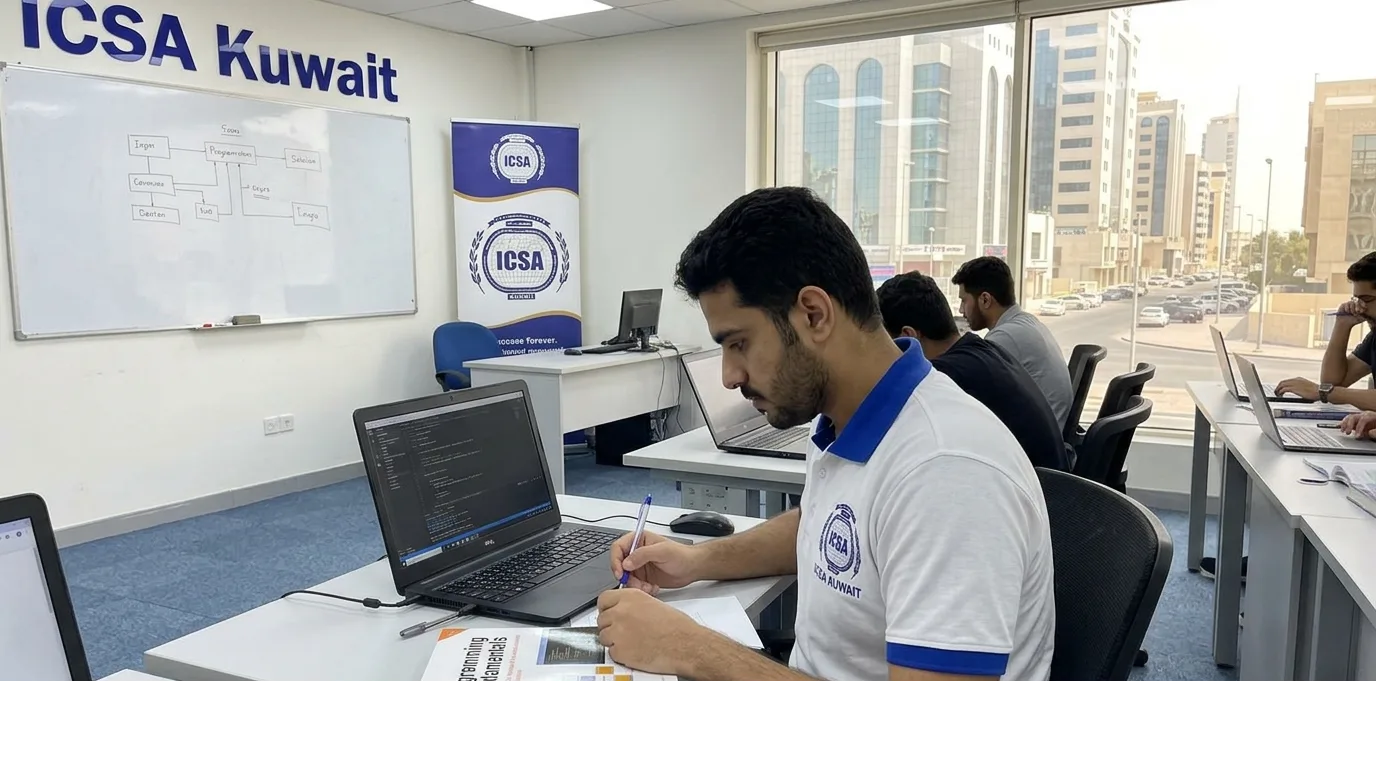
You've heard IT is a good career. You've Googled "how to get into tech" and gotten seventeen conflicting answers, half of which involve paying $4,000 for a bootcamp and the other half involving learning things called Kubernetes, Docker, and CI/CD pipelines on day one. You don't know Python from a python. You're not sure if "networking" means LinkedIn or cables. You've closed twelve browser tabs and felt more confused than when you started.
This article is written for exactly that person. No jargon. No assumptions about what you already know. Just the clearest, most honest map we can draw from absolute zero to a real, paying IT career in Kuwait — based on 23 years of watching people make this transition successfully and unsuccessfully.
The single most important thing to understand before you read further: IT is not one career — it's a family of careers. The path into cybersecurity is different from the path into web development, which is different from the path into networking. The mistake most beginners make is trying to learn everything at once. This article will help you pick a direction first, then go.
First: Stop Googling Randomly and Do This Instead
The internet has an IT content problem. There's too much of it, it's aimed at too many different levels, and almost none of it starts by asking you what you actually want to do. Before you watch a single tutorial or buy a single book, you need to answer one question honestly:
"What do I actually want to do in IT?"
If you don't know yet, that's fine — but don't skip this step by starting to learn things randomly. Here are the four most accessible entry points for someone starting from zero, with an honest description of each:
-
1IT Support / Help DeskThe most direct entry point into IT employment. You help people with computer problems, set up systems, troubleshoot software and hardware issues. Doesn't require coding. Good pay for entry level. Gets you inside a tech environment fast, where you learn more from colleagues than from any course. In Kuwait, this role exists in almost every mid-to-large organisation.
-
2Web / App DevelopmentBuilding websites and applications. Requires learning to code — but modern tools and AI assistance mean the learning curve is more forgiving than it used to be. Huge freelance opportunity in Kuwait. If you enjoy building things you can see and use, this is the most creatively satisfying path for most people.
-
3Networking & InfrastructureManaging the cables, routers, switches, and systems that make organisations' technology work. Very stable in Kuwait — government, oil sector, banking, and telecom all need these roles constantly. Less glamorous than development but extremely in-demand and well-paid. Cisco certifications (CCNA) are the gold standard entry point.
-
4Graphic Design / UI-UXThe visual side of tech — designing websites, apps, brand identities, social media, and digital content. Sits at the intersection of creativity and technology. Very high demand in Kuwait's private sector and growing digital economy. Tools like Figma, Adobe Illustrator, and Photoshop are learnable without a design degree.
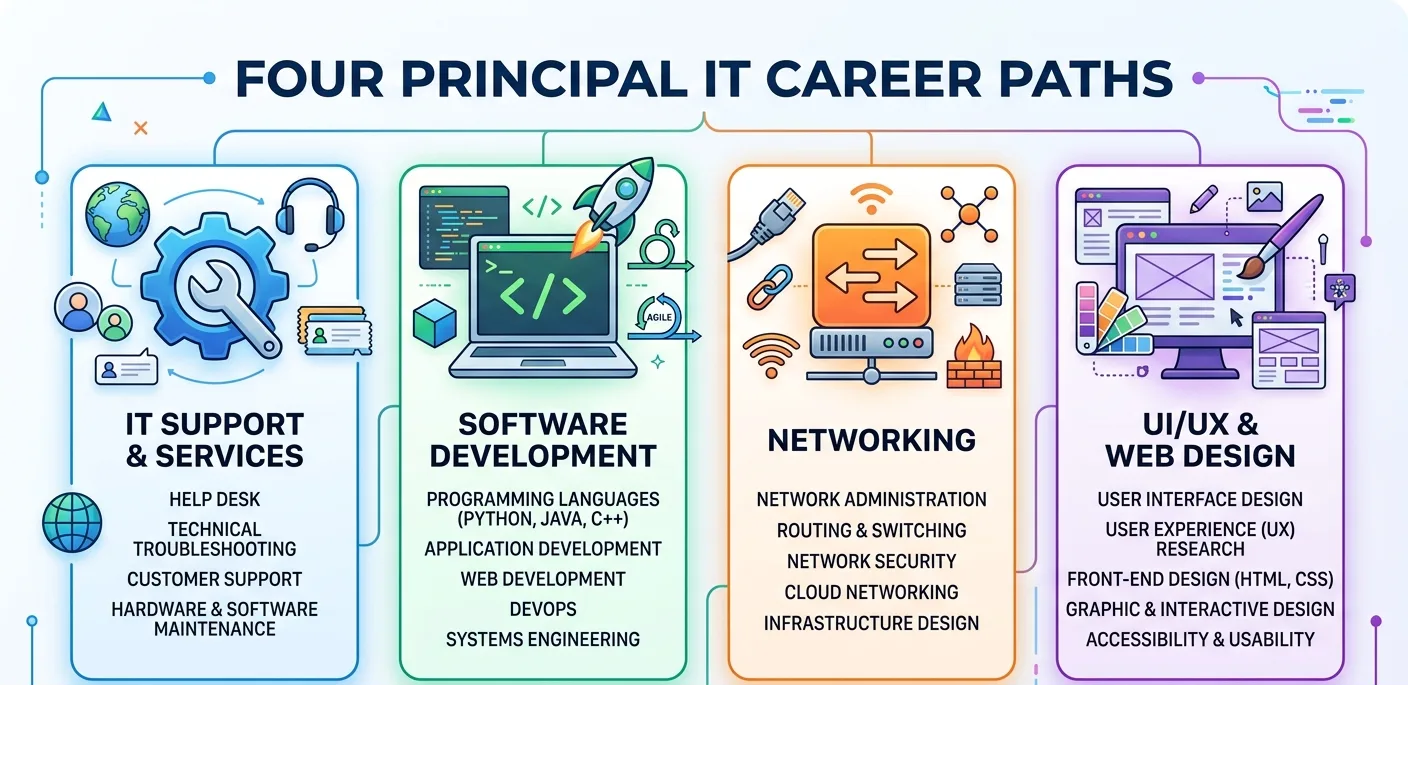
IT isn't one career — it's four main entry points, each with its own learning path, tools, and job market. Picking one before you start is half the battle.
The Foundation Everyone Needs First
Regardless of which path you pick, there's a layer of knowledge that every IT professional needs — and that most self-starters skip because it seems boring. Don't skip it. It will save you months of confusion later.
Understand how computers actually work. Not at a deep engineering level — but enough to know what a CPU does, what RAM is for, how storage works, and what happens when you connect to the internet. This knowledge is the context that makes everything else make sense.
Understand how networks work at a basic level. What is an IP address? What does a router do? What is DNS? What happens when you type a URL into a browser? These aren't difficult concepts — but not knowing them creates a persistent fog that slows down your learning in every other area of IT.
The biggest mistake beginners make is jumping to advanced topics (AI, cybersecurity, cloud) without this foundation. It's like trying to run before you can walk — you'll hit a wall and assume IT is too hard for you. It isn't. You just started in the wrong place.
Get comfortable with the command line. Not expert-level — just comfortable enough that a terminal window doesn't make you close your laptop. The command line is the steering wheel of IT. Learning basic navigation, file management, and simple commands in both Windows and Linux takes about a week of practice and pays dividends for years.
The Realistic Timeline (Honest, Not Motivational)
One of the most damaging things in IT education marketing is the "learn to code in 3 months and get a $100K job" promise. It's not honest. Here's what the timeline actually looks like for most people starting from zero in Kuwait's job market:
Those ranges are wide because they depend enormously on how much time you put in per week. Someone studying 2 hours a day consistently will reach employability faster than someone doing weekend-only binges. Consistency beats intensity every time in skill-building. One hour a day for six months will outperform one ten-hour weekend per month by a significant margin.
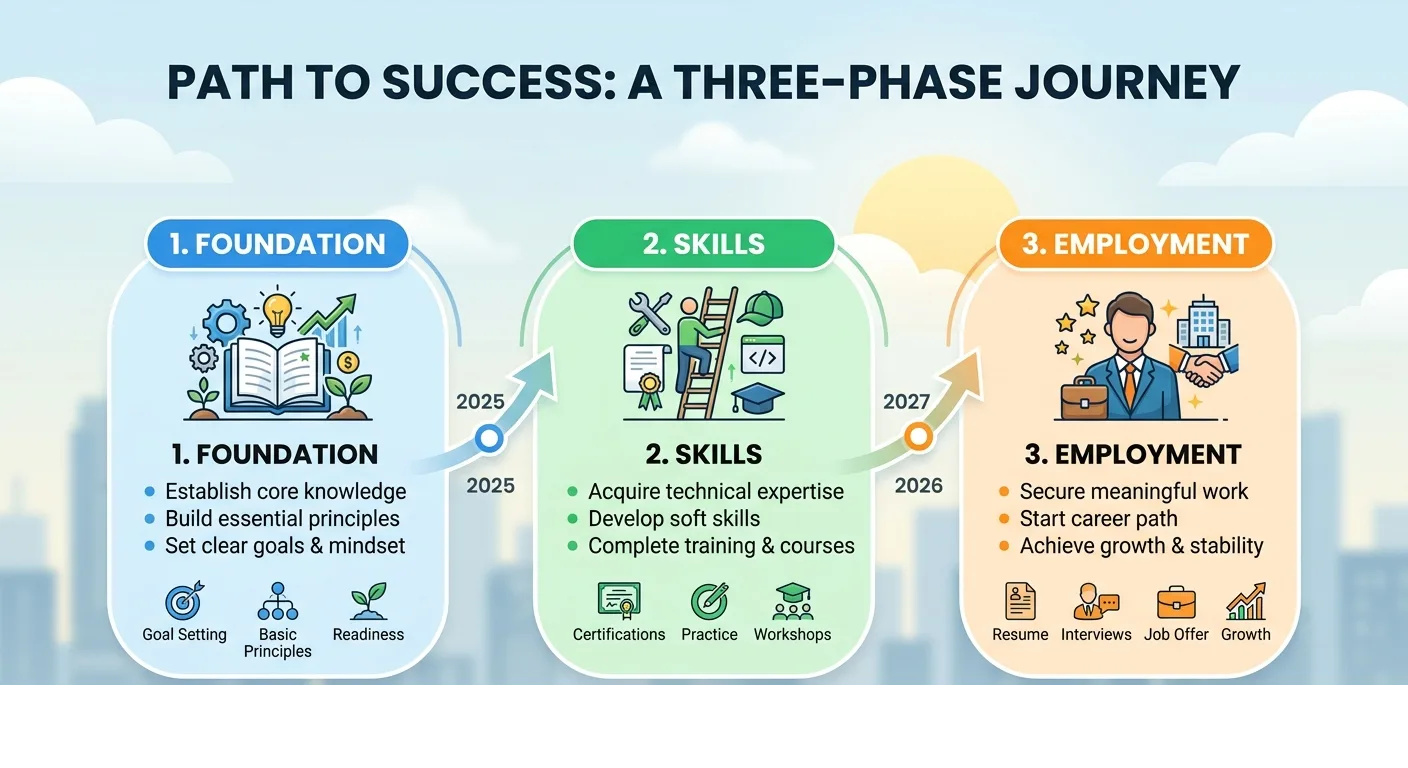
The path from zero to employed in IT is 6–18 months for most people — not 3 months, not 5 years. Consistency matters more than speed.
Path-by-Path: What to Actually Study
Here's the no-fluff, sequenced guide for each of the four entry paths. Follow one — not all four simultaneously.
🖥 IT Support Path
- Start with: CompTIA A+ — the industry standard entry-level IT certification, covering hardware, software, networking basics, and troubleshooting. Widely recognised in Kuwait's private and public sectors.
- Then add: CompTIA Network+ for networking knowledge, or Microsoft certifications (MD-100, MD-101) for Windows environment skills.
- Build toward: IT Support Specialist → Systems Administrator → IT Manager. This path has very clear progression and strong local demand.
💻 Web / App Development Path
- Start with: HTML and CSS — not optional, not skippable. This is the absolute foundation of anything that appears in a browser. Takes 2–4 weeks to get comfortable with. Free resources on MDN and freeCodeCamp are excellent.
- Then add: JavaScript — the language that makes websites interactive. Then either React (for front-end / UI work) or Node.js (for back-end / server work), depending on which side interests you more.
- Build toward: Your first real project — a portfolio site, a tool you actually use, something a real client needs. Certificates matter less than deployed work in development.
🔌 Networking & Infrastructure Path
- Start with: CompTIA Network+ or Cisco's CCNA — both are respected, both are recognised in Kuwait. CCNA is the stronger choice if you want to work in enterprise or government environments.
- Then add: Linux system administration basics (LPIC-1 or CompTIA Linux+), and Windows Server fundamentals.
- Build toward: Network administrator roles in Kuwait's banking, oil, or government sectors — all of which have stable, ongoing demand for this skillset.
🎨 Graphic Design / UI-UX Path
- Start with: Adobe Photoshop and Illustrator for design fundamentals. These are the tools every designer in Kuwait's market is expected to know.
- Then add: Figma for UI/UX work — the industry standard for digital product design. Understanding basic UX principles (user research, wireframing, prototyping) separates designers who get hired from those who don't.
- Build toward: A portfolio of 4–6 strong projects. In design, your portfolio is your CV. No portfolio, no interviews — regardless of your certificate.
The Role of Certifications in Kuwait's Job Market

The path from zero to employed in IT is 6–18 months for most people — not 3 months, not 5 years. Consistency matters more than speed.
In Kuwait's job market, certifications from recognised bodies like CompTIA, Cisco, and Microsoft carry real weight — especially for government and banking sector roles.
Certifications matter more in Kuwait than in some Western markets, for a specific reason: many public sector and large private sector employers use them as a filter. If a job posting says "CompTIA A+ required," not having it means your CV doesn't get read — regardless of what else you know.
That said, certifications are a door-opener, not a career-maker. The people who build long careers in IT are the ones who combine formal credentials with genuine practical skills. A cert that isn't backed by real hands-on experience will get you the interview but not the job. Study to understand, not to pass. The difference shows immediately when an employer asks you to demonstrate something.
"We see CVs every week with five certifications and no real projects. And we see CVs with one certification and a GitHub full of deployed work. The second one always gets the callback."HR Manager, Kuwait IT company — shared at ICSA graduate networking event, 2024
Common Mistakes That Set Beginners Back
Twenty-three years of watching people start IT careers from scratch has given us a clear picture of what goes wrong most often. Avoid these:
- Trying to learn everything at once. Pick one path. Go deep on it. The people who switch between "maybe I'll do cybersecurity, actually let me try Python, actually web dev looks good" never build the depth employers are looking for. Direction first, breadth later.
- Only watching tutorials without building anything. Tutorial completion is not skill acquisition. You can watch 200 hours of web development tutorials and still not be able to build a working website from scratch. Build things. Break them. Fix them. That's where the actual learning happens.
- Waiting until you feel "ready." You will never feel ready. The feeling of readiness comes from doing the thing, not from studying more about the thing. Apply for internships, take on small freelance work, and contribute to projects before you feel confident enough — because that feeling arrives during the work, not before it.
- Ignoring soft skills. The IT professionals who advance fastest in Kuwait are not necessarily the most technically brilliant — they're the ones who communicate clearly, show up reliably, and work well with non-technical colleagues. These things are learnable and they matter enormously.
- Comparing your beginning to someone else's middle. The developers and engineers you see online who look effortlessly competent have been doing this for 5–10 years. You're at month three. Different timelines.

The path from zero to employed in IT is 6–18 months for most people — not 3 months, not 5 years. Consistency matters more than speed.
The best learning environment combines structured guidance with hands-on practice — theory alone doesn't build the confidence employers look for.
Zero Experience Is Just a Starting Point. Everyone Has One.
Every IT professional you've ever admired started exactly where you are right now — knowing nothing, overwhelmed by options, and unsure whether they had what it takes. The difference between the ones who made it and the ones who didn't wasn't talent or prior experience. It was direction and consistency. They picked a path, studied it consistently, built real things, and didn't stop when it got confusing.
Kuwait's IT job market in 2025 is genuinely hungry for people who have practical skills and the right credentials. The demand is there. The question is whether you'll build the supply. The answer to that is entirely in your control in a way that very few career decisions are.
At ICSA, we've helped people make this transition for over 23 years — from school leavers to career changers in their 40s. If you're not sure which path fits your situation, come talk to our team. That conversation is free, and it might save you six months of going in the wrong direction.